
Welcome to this private page for Don’t Eat for Winter book readers…
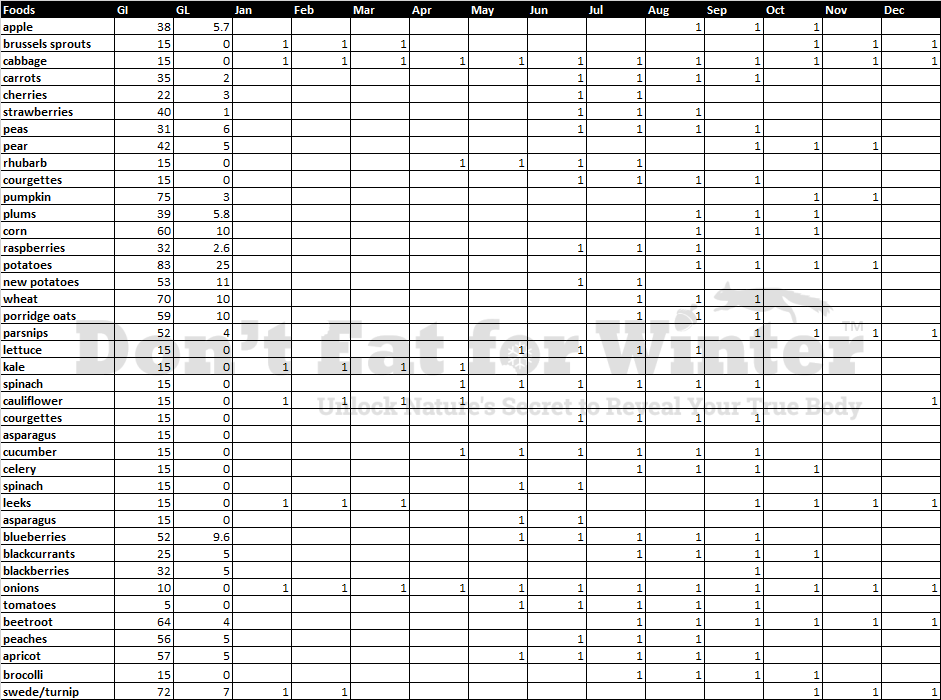
To continue with the theory section of the book in chapter There’s NO Starch in March, essentially what I did was listed all the indigenous plant based foods by their natural harvest time (not including nuts), marking them with a 1 under the month column when ripe, and retrieved their Glycemic Index (GI) and Glycemic Load (GL) values, storing them in their respective columns. I retrieved these values from various sources but the University of Sydney’s Glycemic Index database was used wherever possible: http://www.glycemicindex.com/
I then created 2 other tables to total the GI and GL values…
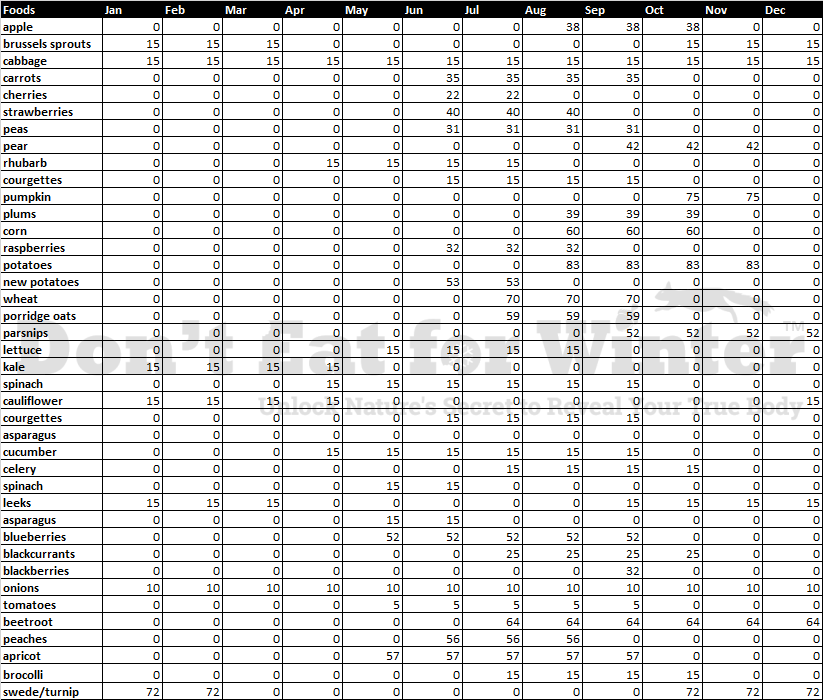
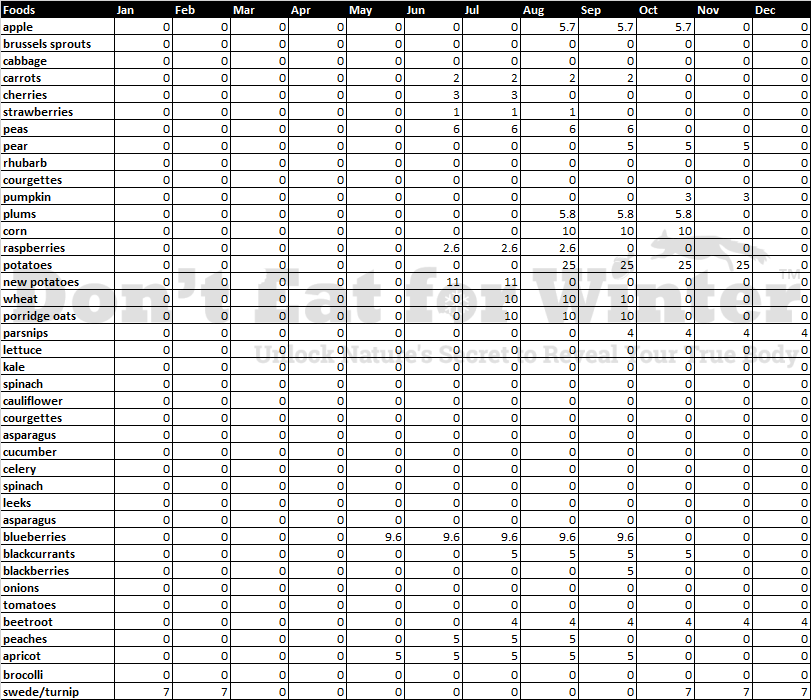
Finally, I plotted these values on a graph and noticed a very pronounced bell-curve showing that there is an abundance of high GI foods peaking in the autumn time, which supports the theory that human beings, through eating of these types of autumnal foods in particular, tend to store fat in order to protect their bodies from the oncoming winter.

Please note, the graph in the first edition of the book is a slightly earlier version of this graph and does not contain glycemic load values but it conveys the exact same point.
Note: Some may point out that potatoes are not indigenous to UK and Ireland, but the graph looks practically the same without them in it, and they are indigenous to places where seasons are also pronounced.


Latest posts by Cian (see all)
- The worst macro combination for fat loss - May 11, 2021
- Top 200 Most Fattening Foods (most autumnal) - March 19, 2020
- Is there such a thing as The Perfect Diet? - November 22, 2019